Let buyers bid before they ever see the lead.
Ping every eligible buyer at once, collect real bids on partial data, and deliver the full record to whoever pays the most. Multi-step ping, circuit breakers, and a log of every request.
Ask first. Deliver second.
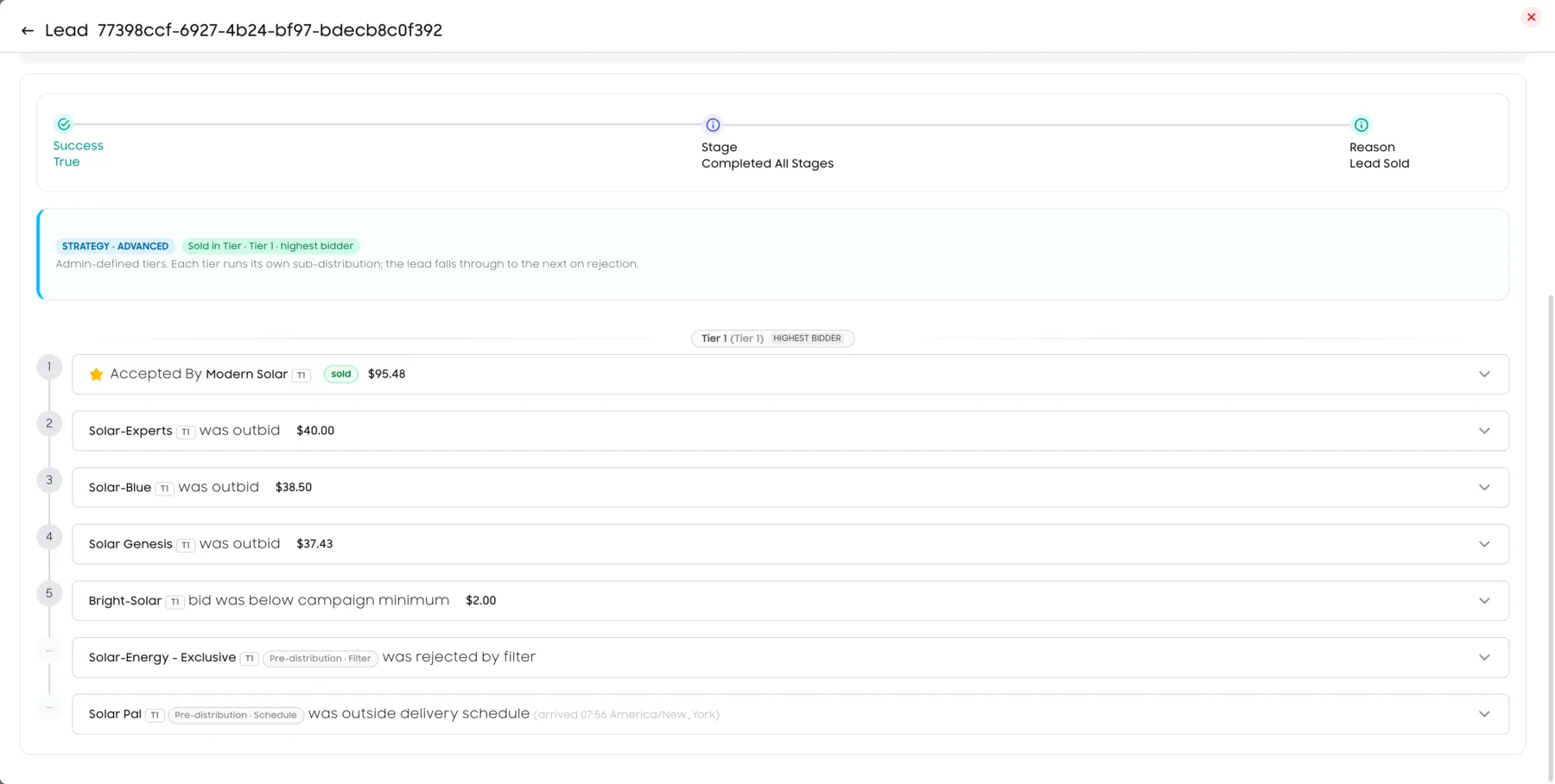
Buyers commit to a price before the lead leaves your hands — and a rejection on the post falls through to the next bid rather than wasting the record.
Ping — buyers bid on partial data
A partial lead record goes out to every eligible buyer at once. Each answers with accept or reject and an optional bid. Bids come back sorted highest first, so the source sees what the lead is worth before the full record moves.
Post — the winner gets the lead
The winning buyer receives the complete record and confirms. The sale is recorded and the postback fires to the traffic source. You decide which fields travel on the ping and which wait for the post.
Rejected on post? Next bidder
A buyer that bids and then declines the full lead does not kill the sale. Datahubb falls through to the next highest bid, so a late rejection costs you a moment, not the lead.
Some buyers price a lead in two passes. Let them.
A buyer can be pinged more than once before the post, and a later step can reference what an earlier one returned. Ask them to score the lead, then ask them to bid on their own score.
- Reference an earlier response with {{$ping_step_1:data.quality_score}}
- Each step can carry its own price — the last one to return a price wins
- Per-step URL, body template, headers, and timeout
The last step to return a price sets the final price.
Built for the buyer who goes down at 2am
An auction is only as good as its slowest participant. The engine is built so that one of them cannot become everyone’s problem.
Concurrent fan-out
Pings run through a dedicated Go service that fans requests out concurrently over a pooled, HTTP/2 connection, prioritising the endpoints that are healthy. The auction takes as long as the slowest buyer you allow — not the sum of all of them.
One slow buyer cannot stall the room
A circuit breaker watches every endpoint. Three failures inside five minutes and that buyer is skipped until it recovers, so a dead integration degrades quietly instead of holding up every lead behind it.
Every request and response is kept
Each attempt is logged at three levels — the session, each step, and the raw HTTP exchange behind it. When a buyer claims they never got a lead, you can show them their own response.
TCPA consent bidding, built in
Flag a lead as consented and the ping changes shape: buyers bid by name, and the consumer decides who is allowed to call them.
Frequently asked questions
Run a real auction on every lead.
Start your 14-day trial. Full platform access. Card required, no charge if you cancel during the trial.