The traffic you throw away is still worth money.
Put a wall of paying offers in front of the leads that didn’t sell and the visitors about to bounce — ranked by what actually earns, and matched to what you already know about the person.
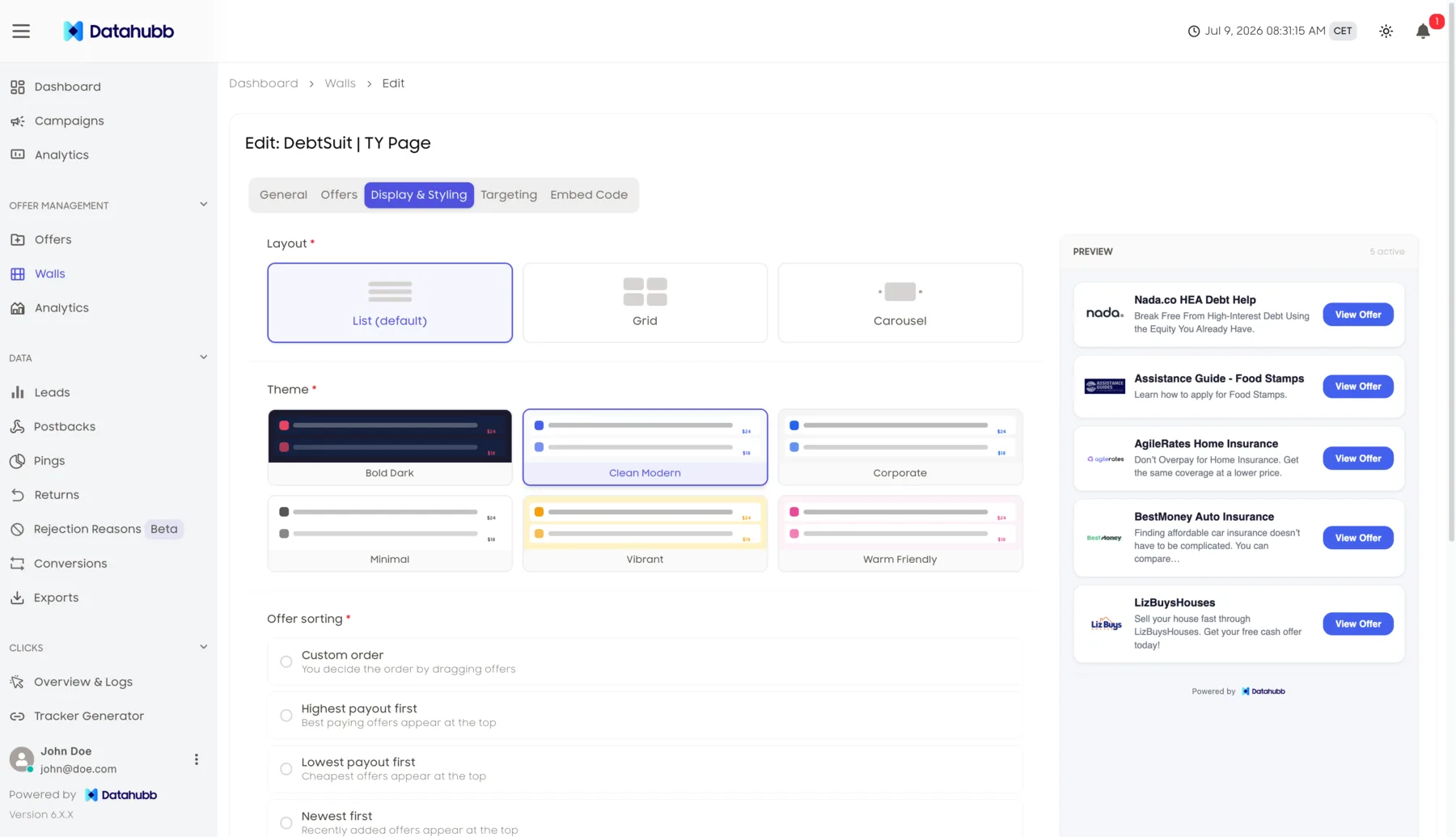
A second way to get paid for the same visitor
The lead sold, or it didn’t. Either way the visitor is still on your page, and they are still worth something to somebody.
The traffic you already paid for
A lead that did not sell, a visitor about to bounce, a thank-you page nobody monetises. That traffic cost you money to acquire. A wall gives it somewhere to go that pays.
A wall you can actually style
List, grid, or carousel, with themes and your own CSS. It sits on a publisher’s page and looks like it belongs there, not like an ad unit someone bolted on.
Sorted by what earns, not what promises
Rank offers by the revenue they have actually produced over the last 30 days. The offer with the biggest advertised payout and no conversions drops down the wall by itself.
Offers matched to the person
Gate each offer on what you already know — debt amount over 10,000, a credit score in a band, a state. A visitor only sees the offers they could plausibly convert on.
Geo blocking that cannot be spoofed
Country comes from the visitor’s IP, resolved on the server. It is not a query parameter a publisher can set or forget, which is the only way a geo block is worth having.
Send the advertiser what you know
Forward the consumer’s own fields into the destination URL — debt amount, credit band, zip. Attribution keys are protected, so nothing in a supplier’s payload can hijack the click.
The best-paying offer is rarely the best offer
Advertisers quote a payout. What matters is the revenue an offer has actually produced from your traffic. Datahubb ranks the wall on the last 30 days of earnings, so the offer that promises the most and converts the least sinks without you noticing it.
- Ranked on revenue actually earned, not the advertised payout
- Precomputed, so sorting the wall costs nothing at serve time
- Or sort by EPC, CPM, newest — or drag them into your own order
The best-paying offer on paper is the worst earner — so it sinks.
Two ways to put a wall on a page
Give a publisher a snippet, or give them the data and let them build it. Either way the tracking is the same.
Frequently asked questions
Stop letting good traffic bounce for free.
Start your 14-day trial. Full platform access. Card required, no charge if you cancel during the trial.