Route every lead to the highest-paying buyer.
Deliver by direct post or ping/post, and route with four strategies — Highest Bidder, Waterfall, Weighted, and Advanced — from one platform. Real-time routing, real caps, and a record of every decision.
Routing strategies
Delivery methods
Integration providers
Per-lead fees
One platform. Four ways to route.
Every buyer relationship is different. Pick the strategy that fits each campaign — or stack them in tiers — and let Datahubb sell each lead for the most it can.
Highest Bidder
Ping every eligible buyer at once and let them bid in real time. Bids come back sorted, and the lead goes to the top one — a live auction on every record, so nothing sells for less than the market will pay.
Waterfall
Offer each lead to buyers in the priority order you set; the first to accept wins. The right shape for exclusive and preferred-buyer relationships, where order matters more than price.
Weighted
Give each buyer a target share and Datahubb steers toward it, sending every lead to whoever is furthest below their number. It corrects itself when a buyer rejects, so weights track leads actually won — not leads merely offered.
Advanced
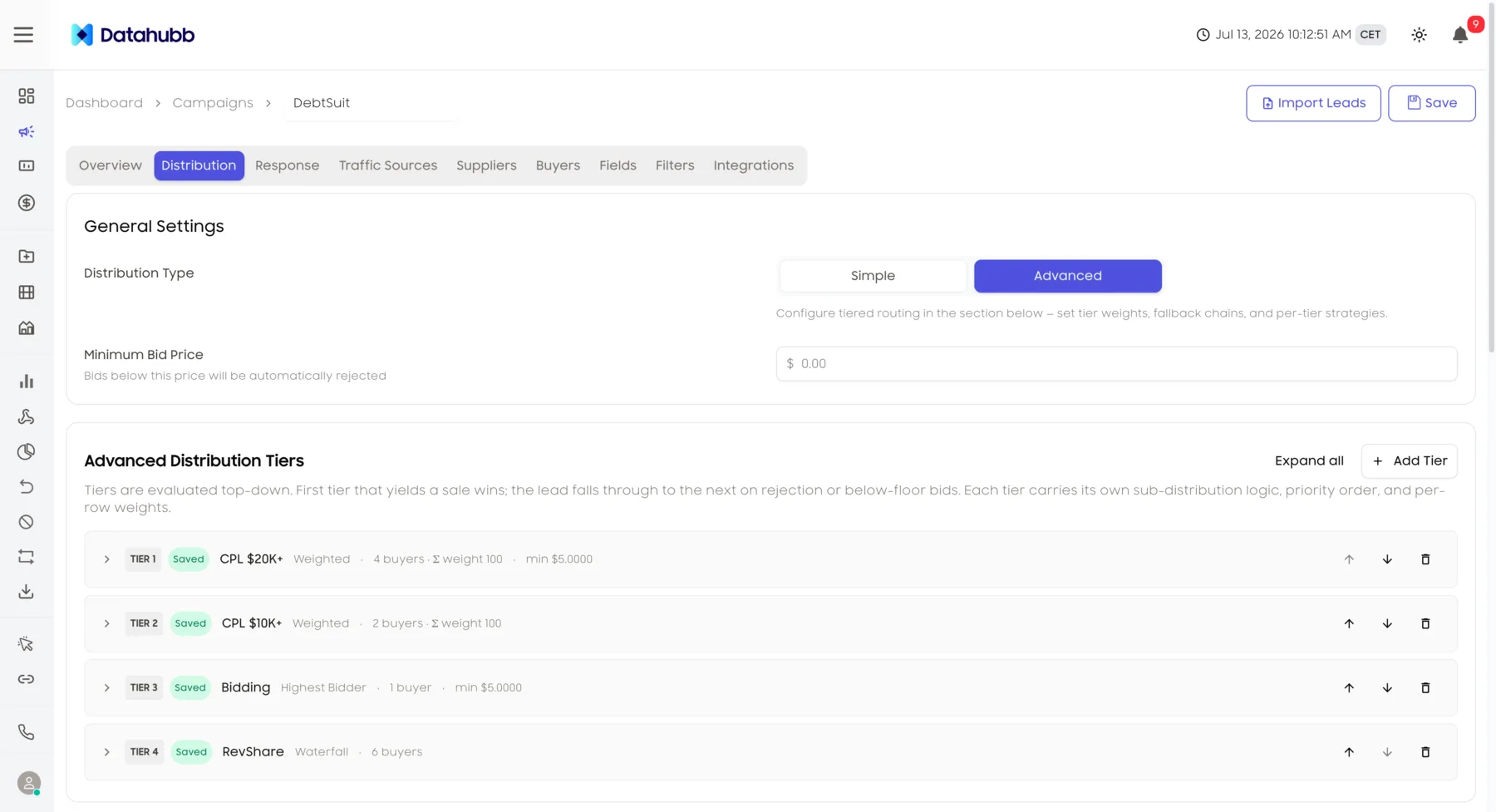
Stack buyers into ordered tiers, each running its own sub-distribution behind its own minimum-payout floor. A premium Weighted tier on top, a fallback tier beneath — leads fall through tier by tier until a buyer accepts.
Caps that hold, in the buyer's own timezone
Set daily, weekly, monthly, and lifetime limits per buyer — on lead volume or on spend. Datahubb checks them as the lead is routed, so a buyer at their cap is skipped rather than oversold.
- Volume and budget caps, per period
- Timezone-aware day boundaries and schedules
- A capped buyer is skipped mid-route, not after the fact
Decide who gets first refusal
Drag buyers into the order you want them tried. Datahubb walks the list on every lead, checking schedule, filters, and caps at each step, and falls through the moment a buyer declines.
- Fixed priority order you control by dragging
- Schedule, duplicate, filter, and cap checks at each step
- Automatic fallthrough to the next buyer on rejection
Every buyer wants a different payload. Fine.
Map your lead fields to any buyer's API without touching code. Rename fields, inject static values, and reshape phone, email, and date formats per buyer — then send it as a form or JSON body.
- Per-buyer field renaming and static values
- Chainable transforms on phone, email, and dates
- Value mapping — send "California" where you store "CA"
Know what a lead sold for, and why
Routing you cannot explain is routing you cannot defend to a buyer. Datahubb records the reasoning behind every lead it places.
Every routing decision is on the record
Each lead stores why it went where it went: the strategy that ran, the sorted bidders or deficit order, the winning tier, and the outcome. When a buyer asks why they did not get a lead, you have the answer instead of a theory.
Price resolution you can predict
A fixed order decides what a lead is worth: a filter payout override wins first, then the buyer bid, then their fixed price, then the campaign or per-tier floor. Negative prices are guarded at multiple layers.
Sources see their payout, not the bid
The ping response returns what the traffic source will actually earn, after supplier margin — not the buyer’s raw bid. Your margin stays yours, and partners get a number they can trust.
Built for the teams selling the leads
Frequently asked questions
How to choose and route lead distribution
Ready to replace your lead distribution stack?
Start your 14-day trial. Full platform access. Card required, no charge if you cancel during the trial.