Pay your sources the moment the buyer confirms.
A CPA lead sells as pending and books nothing. Days later the buyer’s postback confirms it, the sale flips to sold, and the payout fires out to the source that sent it — without anyone reconciling a spreadsheet.
The conversion lands late. The money still lands right.
A CPA buyer does not owe you anything the moment you deliver, so Datahubb books nothing: the sale is pending, source payout is zero, and no revenue is claimed. When the confirmation postback arrives — six days, three weeks — the sale flips to sold, the revenue and payout entries fire, and your source is told it earned. If the buyer declines instead, the sale closes with nothing to unwind.
- No revenue and no source payout booked until the buyer confirms
- The revenue and payout pair fires exactly once, even if the postback repeats
- A per-buyer confirmation window closes out anything that never converts
Every conversion is matched to a record, or refused.
An inbound postback carries one id, and what that id means depends on the event: a click conversion carries the click’s id, a lead confirmation carries the lead id and the buyer, a call carries the call id, an exit offer carries the lead’s external id. Each one is looked up against the record it claims to be about. An id that matches nothing is refused outright — no guessing, no orphan row, no revenue attached to a lead nobody can name.
- The click id ties the conversion back to the click, the source, and the lead it produced
- A repeat conversion on the same click and buyer is marked duplicate, not paid twice
- The resolution trace names every config that fired, skipped, or was suppressed — and why
Inbound, outbound, and the accounting in between
Conversions arrive from your buyers and networks. Postbacks go out to your sources on the events they care about. The ledger stays true across both.
One inbound URL, six kinds of outcome
Buyers, networks, call trackers and ad servers all report to the same endpoint on your domain: cpc, cpl, cpa, ppc, exit and lead. The event tells Datahubb which record to go find.
Pending until the buyer says otherwise
A CPA sale books nothing at delivery. On an accepted postback it flips to sold and the ledgers fire; on a rejected one it closes with nothing to reverse, because nothing was ever booked.
Outbound on the events you pick
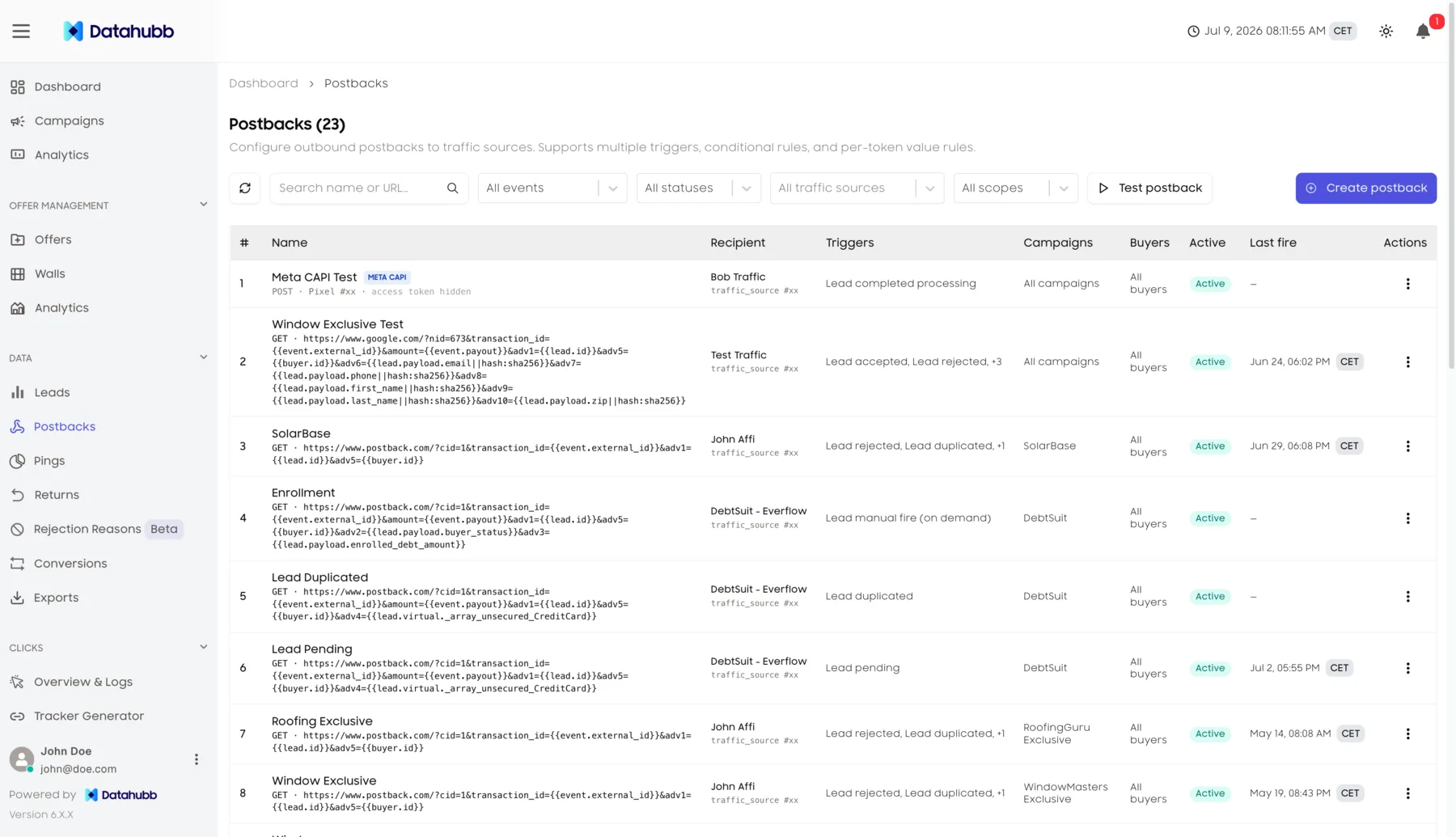
Each source gets its own configs — its own URL, method, body, headers and secret — subscribed to the events it cares about: lead sold, lead rejected, click converted, call converted, exit converted.
Gated before it fires, not after
Campaign and buyer scopes, a minimum payout, click-type filters, and AND/OR rule groups. If no primary config matches, a fallback tier fires instead — so a source is never left with silence.
Tokens that survive contact with real data
Build the URL or JSON body from tokens like {{event.payout}}, with transformer chains for phone, date, case and encoding. A missing key resolves to empty rather than shipping a broken URL.
Affiliates can wire their own pixel
A traffic source can point a Meta CAPI postback at their own pixel through a structured form — pixel id, event, user-data mapping — without you hand-authoring a URL and JSON body for them.
Your partner can prove it came from you.
Anyone can post to a URL. Give a config a signing secret and every outbound send is signed with HMAC-SHA256 over the method, the URL and the body, and carries the signature, the algorithm and the version as headers. Your partner recomputes the signature with the shared secret and drops anything that does not match — which is what makes a postback safe to act on financially.
- Signature computed over method, URL and body — not just the payload
- Algorithm and version sent as headers, so the check can be verified and rolled forward
- Every send is logged with its URL, headers, response status and body
Frequently asked questions
Stop chasing conversions you already earned.
Start your 14-day trial. Full platform access. Card required, no charge if you cancel during the trial.